Pudsey Family History Fair

If you were in Pudsey over the weekend then perhaps you would have seen us at the Pudsey Family History Fair. It was the place to be for up and coming historians as well as expertise knowledge from a variety of Archives and Local History Societies.

Members of the public speaking to archive staff

Members of the public speaking to archive staff

If you feel you missed out or would like to learn more about archives then we do have an ‘Introduction to Archives’ talk on 22nd May.  It includes a behind scene tour of our excellent new archive storage facility. To book a place for this event then just contact the email address below.

It was excellent to see a variety of people and the support for the Wakefield bid was immense. Thank you for all those people who filled in our visitor surveys. A ‘development grant’ was awarded from the Heritage Lottery Fund to advance our ideas. Therefore it was very helpful for us to understand what you would like in an archive building and how we can make it happen. This will lead into a new building for Wakefield and West Riding Archives.  

Members of staff showing off our display. From right to left, Teresa Nixon (Head of Archives), Nicola Kenmir (Project Outreach Worker) and Alison Depledge (Archive Assistant)

Members of staff showing off our display.
From right to left, Teresa Nixon (Head of Archives), Nicola Kenmir (Project Outreach Worker) and Alison Depledge (Archive Assistant)

At the fair you had the opportunity to learn how to make a family history scrapbook. There were many guides and resources to buy to help you with your family history. As well as a sensational Victorian clothing display! We would like to see a huge thank you Jackie Depelle for organising such a fabulous event.

Victorian clothing display

Victorian clothing display

If you could not make it then don’t worry because we will be at York Family History Fair on 29th June where we can tell you all about our collections, update you on the Wakefield plans, give you free advice as well gain your valuable opinions on our archive service.

In the meantime you can always contact us, if you have any queries. Please contact us at archives@wyjs.org.uk  

Gruel, Grime, & Guardians: Poor Law and the Workhouse

Up to 1844 in Leeds the Poor Law was carried out by the Parish and Chapelry Vestries. The Poor Law Amendment Act of 1834 resulted in the Board of Guardians being set up. In 1861 four additional unions were created within the borough. The pre 1844 records are arranged under townships, many of which were amalgamated to form Unions.  The bulk of these records came from the Leeds Public Assistance Office in 1949.

In the collection there is a variety of records such as Admission and Discharge registers, Minute books, Letters, Bastardy Orders and much more. I hope to catalogue the whole collection to make it more accessible to the public. I will also do a talk at Leeds Central Library and the Archives. This will allow researchers to gain an understanding of the records we do hold and how to use the records for their research.

An aim of mine is to write a blog on each section which will lead up to my talk in September. I have just finished cataloguing section 5 which is Relief Order Books.  Relief Order Books show how much financial or other assistance were given to those in need. Here are some interesting records I have found when cataloguing.

An attention grabbing document would be the Warrant Book. It shows warrants issued by the relieving officer due to paupers deserting their families. The remarks on appearances are outstanding, for instance it illustrates that Jacob Renalt (Reynolds) had a ‘bullet wound between his finger and his thumb’.

Register of Warrants, 1900-1954, PL/5/11

Register of Warrants, 1900-1954, PL/5/11

The Admission and Discharge register which includes the individuals’ date of birth, the parish they belonged to, cause of relief and individuals it mentions observations on conditions at the time of admission. For instance James Kirby who was born in 1784 and admitted in 1846 was destitute. His condition was seen as ‘dirty, filthy and nearly naked’.

Admission and Admission and Discharge register, 1843-1843 PL/5/1a

Admission and Admission and Discharge register, 1843-1843 PL/5/1a

Furthermore, the relief section can also allow one to understand how paupers  lived especially by examining the workhouse dietary sheet. The curiosity to find out how these paupers lived prompted my colleague Gary Brannan to try the diet. He found it difficult to eat the large amount of ‘dry bread with only a little bit of liquid’. Furthermore the ‘cocoa was very heavy’ but on a whole the breakfast was ‘flavourless mush with very little to go on’. Therefore you can imagine how they felt!

Workhouse Diet Sheet, 1877, PL/5/16/11

Workhouse Diet Sheet, 1877, PL/5/16/11

There are many interesting facts and figures to observe for many different research purposes but it is still fascinating for anyone to see how people were classed, how they were observed and how they lived in the workhouse.

If anyone has any stories they would like to share regarding their ancestors in the workhouse, questions or would simply like to get involved in the project then please do contact us.

By Ameena Mughal

Link to Gary Brannan’s blog

http://workhousediet.blogspot.co.uk

Sources used:

Register of Warrants, 1900-1948, PL/5/11.

Admission and Discharge register, 1843-1847, PL/5/1a.

Workhouse Diet Sheet, 1877, PL/5/16/11.

Wakefield news…

Consultation is now well underway to help develop our plans for a brand new home for the Wakefield and West Riding archives, currently housed in the Registry of Deeds building.

A Heritage Lottery Fund ‘development grant’ was awarded at the end of 2012 which will help us develop our ideas for a larger application to the Heritage Lottery Fund. This will secure enough funding to build a new home for the Wakefield and West Riding archives.  Next year, we will be submitting a bid to the funders which will outline our architectural plans for a new building; information on how it will improve the condition and management of the collections; the activities and audience engagement programmes that will operate from the new building and the impact this will have on the protection of and access to West Yorkshire’s heritage.

Image

The Registry of Deeds: much-loved and unique – but not fit for our purposes.

The Registry of Deeds building itself, although much loved by staff and visitors, has been deemed ‘not fit for purpose’ by The National Archives.  During their survey of the building in 2009 they also cited the inaccessibility of the building to disabled visitors and recommended that even with a regular maintenance programme and improvements it would be ‘difficult to overcome the problems associated with a building never intended for archive preservation and public access’.   Sadly, the cost of refurbishing the Registry to acceptable archival standards and making the building meet current Equality Act legislation is too prohibitive. Therefore, the funding we seek will be for a brand new building which will form part of the wider Kirkgate regeneration plans for Wakefield.

Image

Storage of the collections is in desperate need of improvement

As the official place of deposit for the former West Riding of Yorkshire the Archive collections held at the registry cover a huge variety of subjects and a geographic area that stretches from Sedbergh down to Sheffield.

C599_2

The former West Riding of Yorkshire. A mighty county of many a vista….

As well as the archive collections we will also be working alongside West Yorkshire Ecology service and West Yorkshire Archaeology Advisory Service, who provide access to the Historic Environment and Ecological Records for the county and with whom we share the current building.  The new facility will provide a single one-stop shop in the best possible accommodation for all our services, their staff and visitors. This enormous collection of knowledge, expertise, resources and records will be housed together in one purpose built and fully accessible facility.

ImageImage

This project has generated an exciting opportunity for the service to assess and improve the way in which it interacts with residents and institutions across the region.  Work has already begun to consult with key groups of users and non-users and to talk to them about how they would like to work with the new facility, what they expect, what they would like and what we can do to make it happen.

A wide variety of groups representing the local community and the wider region will be consulted throughout the planning process. The current priorities are to engage local school groups in order to develop a new learning programme for the service. We are also working to introduce local communities to some of our extensive county-wide collections – including the vast collection of records acquired from the National Coal Board.

This has created an exciting opportunity to work on a collection of national and regional significance which until now we have not explored fully.

Davy lamp

Concordia Miners’ Safety Lamp advert from 1939 held in our collection of mining related records

If you are interested in helping to shape the future of our Wakefield office please get in touch and do come along to one of our events: educationoutreach@wyjs.org.uk

Image

Conserving South Pennines Maps

The South Pennines History Group (Hebden Bridge, Marsden and Saddleworth Local History societies) secured funding for a 3 year project funded by LEADER (Liaison Entre Actions de Développement de l’Economie Rurale).  LEADER is a community-led rural development programme which aims to improve the quality of life and prosperity in rural communities through locally driven rural development initiatives and projects. 

Project managed by Nigel Smith, the group arranged for conservation and scanning of fifteen 18th and 19th century archive maps of the South Pennines area from West Yorkshire Archive Service’s (WYAS) collection at its Calderdale Archives. This mutually beneficial initiative has resulted in both WYAS and the South Pennines History group now having digital copies of the conserved and enhanced maps.  

WYAS’s Conservation studio undertook conservation on eight of the maps. Five parchment and three paper maps all required cleaning to enhance the images – some of the maps had become very faint and were rather difficult to read.

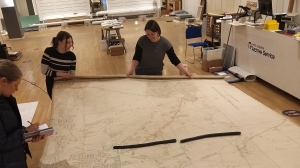
Two parchment maps required gentle humidification and flattening as they had been stored folded.  Parchment being an animal skin can be extremely difficult to handle once folded. Humidification can be used in order to make the parchment responsive to flattening.  Once the skin is relaxed it is pressed between woollen felts, under weight and allowed to dry for at least 48 hours.  Once flatter a clearer digital image can be obtained without the possibility of distortion from cockling.

All part of document conservation!

Two of the other parchment maps required repair.  One had suffered extensive losses along the bottom edge of the roll, which had at some point in the past become damp and had suffered mould damage.  The extreme weakening of the fibre structure was supported using alum-tawed goldbeaters’ skin and a gelatine adhesive.  The other parchment map required repair along the lifting joins of the sheets using a gelatine adhesive.

One of the paper maps required quite extensive conservation work.  The map had been previously repaired and lined on very heavy paper and cloth.  The lining was so stiff it was difficult to unroll.  There was also a crack running completely across the width causing the map to ‘tent’ and not lie flat for imaging.  This was difficult to remedy without removing the pervious lining materials and relining on a strong yet flexible Japanese paper lining. 

Another paper map needed to be detached from its wooden roller to prevent strain whilst being handled and stored.  Its edges were damaged and vulnerable at the open end, these were supported from the back with Japanese tissue adhered with a wheat starch paste. 

Each map was provided with archival packaging.  The two parchment maps that had been flattened were packaged flat; other larger maps had to be stored rolled.  Archival polyester sheeting  enables users to view the document without directly handling it (parchment is not always stored in this material due to the static nature of the polyester).

Giving it a good clean…

 Each maps is supported in the centre with a hard cardboard tube protected with an archival paper cover and placed in a white breathable polyester bag.

The conserved and packaged maps (plus the other seven maps which required no conservation) were taken to Northlight Studios in Elland.  Northlight photographic studio deal in a wide range of services including photography for advertisement, fashion and heritage.  The majority of the maps were photographed in sections due to their size and then merged together using Photoshop in order to get a high quality digital image.  These images are now held by both the Hebden bridge archive and the West Yorkshire Archive Service.

This collaboration has aided in the long term preservation of these unique maps both by conserving the originals and also providing surrogates.  It has also aided in Project Manager Nigel Smith’s phD research into historic development of the area.

The provision of surrogates in the searchrooms at the West Yorkshire Archives Service is not to prevent people from using original archives but to promote the long term preservation of our collections.  The images provided are of such a high quality that it in fact makes it easier to view some of the maps that are so large and faded and preventing any risk of further damage due to their unwieldy size.

Jowett Journey across Africa

The Jowett Motor Manufacturing Company was established in Bradford in 1901 by Benjamin, William and Ruth Jowett.  The company initially designed and built engines but designed a car in 1906.  They decided to commercially produce the car in 1910, manufacturing almost 50 cars between 1910 and 1916. Some Jowett records were collected by the Jowett Car Club, whose aim was to uphold the tradition and reputation of Jowett vehicles, promoting competitive events and social meetings and providing practical assistance to Jowett owners.  The Jowett Car Club collection was deposited with us in March 2007.  Reference: WYB324.

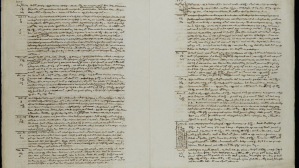
picture 1

REF: WYB324/12/1, Scrapbook, Feb 1926 – Oct 1926

The Jowett Journey to Africa first began when Mr Frank Gray (Ex Oxford M.P) accused British Manufacturers of producing the ‘wrong type of car’ for overseas use. Jowett Cars Limited propositioned Mr Gray to travel across Africa, a challenge he accepted.

On 16th March 1926, Mr Gray and Mr Sawyer embarked on their journey from Lagos to Jebba, Bida, Zungera and Zaria, crossing the Niger at the Jebba railway bridge. Having read the story by Jowett Limited, this event made history as it had never been attempted on any form of mechanical transport. Furthermore, it had to be done in the shortest time possible as no advance arrangements had been made for petrol, oil or any mechanical assistance. It was the 1920s version of a Top Gear challenge.

REF: WYB324/12/1, Scrapbook, Feb 1926 – Oct 1926

REF: WYB324/12/1, Scrapbook, Feb 1926 – Oct 1926

The story illustrates the difficulties faced by the Jowett cars and drivers during the journey such as crossing the Bunga ‘river’ which was a wide stretch of sand, deep and soft; or driving over the mountain range Ouera which they simply describe as ‘caked mud’. It also refers to their relationship with the natives and how an ‘Arab begged them to take some clean and really good water’ as well as how they had to convince the officials that they were not political agents. By the 31st May 1926, the journey had been completed.

Newspapers such as The Sketch commented in June 1926 that this event proved that ‘British built motor vehicles can give full satisfaction to its owner in any clime… and the sooner people stop scoffing at British products the better’.  This shows a triumph in British Engineering, it represents Bradford and Yorkshire at its finest. Mr Gray and Mr Sawyer were invited to a Civic Reception at the Midland Hotel in Bradford to commemorate their trip.

picture 3

REF: WYB324/12/1, Scrapbook, Feb 1926 – Oct 1926

The Jowett Car Club Collection is one of the treasures of Bradford Archives. It consists of copies of Jowett road tests from early editions of motoring magazines such as Autocar and The Motor. There are instruction books for various models, sales catalogues, illustrated price lists, various technical diagrams and information. It shows Bradford in its prime and glory, so please do come and see!

Documents used to write this blog were (REF: WYB324/12/1, Scrapbook, Feb 1926 – Oct 1926 and REF: WYB324/17/2/8, Across Africa by car in 60 days, 1926).  By Ameena Mughal.

Achieving Great Things! The Archive Service Collections Week March 2013

11-15 March saw much activity in all of our offices!

For two weeks a year, WYAS closes to the public in order to focus on working on our local authority and other collections – collecting, sorting and listing them and finally putting them on-line so that everyone can remotely access our lists!  CalmView (our public database currently has 543,734 entries relating to the collections we hold – http://catalogue.wyjs.org.uk/)

In Wakefield, where we are currently undertaking a major survey of all the holdings in preparation for stage 2 of the WYAS Lottery Bid for a state-of-the-art new facility, teams of staff worked on re-boxing over 44,000 mental health files. This involved the delivery of 1o00 empty archival boxes, most of which were delivered during a snowstorm!

MoreBoxes

The contents of two rooms were also barcoded (1952 boxes, outsize items and volumes).  The success of barcoding with the recent Leeds Archives move from Sheepscar to Morley means that Wakefield are following the same plan.  By the end of the week staff were exhausted and truly battered by the good old British weather!

At Calderdale Archives staff began barcoding boxes in preparation for moving to new premises in 2015.  An amazing 10,338 containers were barcoded and by the end of the week, statistics for the total number of boxes of each size held and a sample of box weights were gathered which will be used to design the new storage facilities and provide the Architects the information they need for the proposed new library and archive building.

In the Bradford, Kirklees and Leeds Offices, there was significant progress with local authority collections.  In Bradford, the cataloguing of private street works boxes relating to Bradford, Baildon, Bingley and Shipley was done and a large collection of Bradford Corporation drainage agreements dating to the 1930s was also collected.

In Kirklees, staff sorted the Kirklees Council Building Control Plan fiche into fiche cabinets.  In the Leeds Office, 1087 new entries were added to the database following work on LC/PARKS, the LC/POLICE collection was renumbered in line with the new council structure (now LLD7) and 488 new catalogue entries for LC/HEALTH were added into CALM.  The results of all this is that some really great records are now searchable online including some notification of birth registers and zymotic disease registers. Board of Guardians’ records were repackaged and listing was done of some of the main series of letter books in the collection. There are now over 1400 records in CALM for a collection which previously didn’t even have a collection level description in there.  Finally work was started on preparing wills for digitisation.  About 400 probate bundles were prepared for the Ancestry team to start flattening.

Tired but happy with our achievements, staff are now back to usual service!

Nostell Priory – Country House, Chippendale and Coal

West Yorkshire Archive Service is delighted to announce that it has been awarded a grant of £37,000 from the National Cataloguing Grants Fund to complete and improve the catalogue of the archives of the Winn family, Barons St Oswald of Nostell Priory.

This is the premier family and estate collection for Wakefield district held by the Service, and as the National Cataloguing Grants Fund said in its press release – “The collections funded represent some of the most fundamental and fascinating archival holdings in Britain: the records of businesses, families, religious and arts organisations which are at the heart of understanding significant parts of our national story”.

In 2011, the Archive Service held a public vote in each district on the collection considered to be a “Treasure of the Archives”. The Nostell collection easily won in Wakefield district with 40.73% of the vote (the runner up only receiving 24.5%). 

Recipe for 'Pea Soop'. Ref :WYL1352/C4/8/2

Recipe for ‘Pea Soop’. Ref :WYL1352/C4/8/2

The collection is a rich source of information about the involvement of the Winn family and their architects and craftsmen in the building, furnishing and management of the house and its estate.

Nostell Priory is regarded by furniture historians and others very much as a flagship country house. It has magnificent plasterwork interiors by Robert Adam and James Paine, and has an outstanding collection of Chippendale furniture, made specifically for the house 1766-1776. Many bills and letters have survived relating to Adam, Paine and Chippendale, but further cataloguing of them is needed.

There are also personal papers of the Winn family dating from about 1610 to 1999. Over the past four centuries the Winns have played a significant local role as landowners and coal owners, as political leaders and holders of public office, as employers, patrons and benefactors, and as a focus of local society.  The collection also includes manorial records from 1605 to 1745, and estate records dating as far back as 1215, when King John confirmed an earlier grant of Nostell to the Priory of St Oswald.

The estate records document the lives of thousands of local people who lived and worked on the Nostell estates, and present an often-overlooked picture of the local rural economy which pre-dated, and later co-existed with an industrial economy based on coal-mining. When fully listed, these records will complement the Service’s other extensive holdings relating to coal mining in West Yorkshire. 

The project will last for a year and the Service will be working closely with the National Trust at Nostell Priory, the Chippendale Society and other partners.

For further information on the project or on the collection, please contact the Collections Team on archives@wyjs.org.uk or telephone 0113 3939767